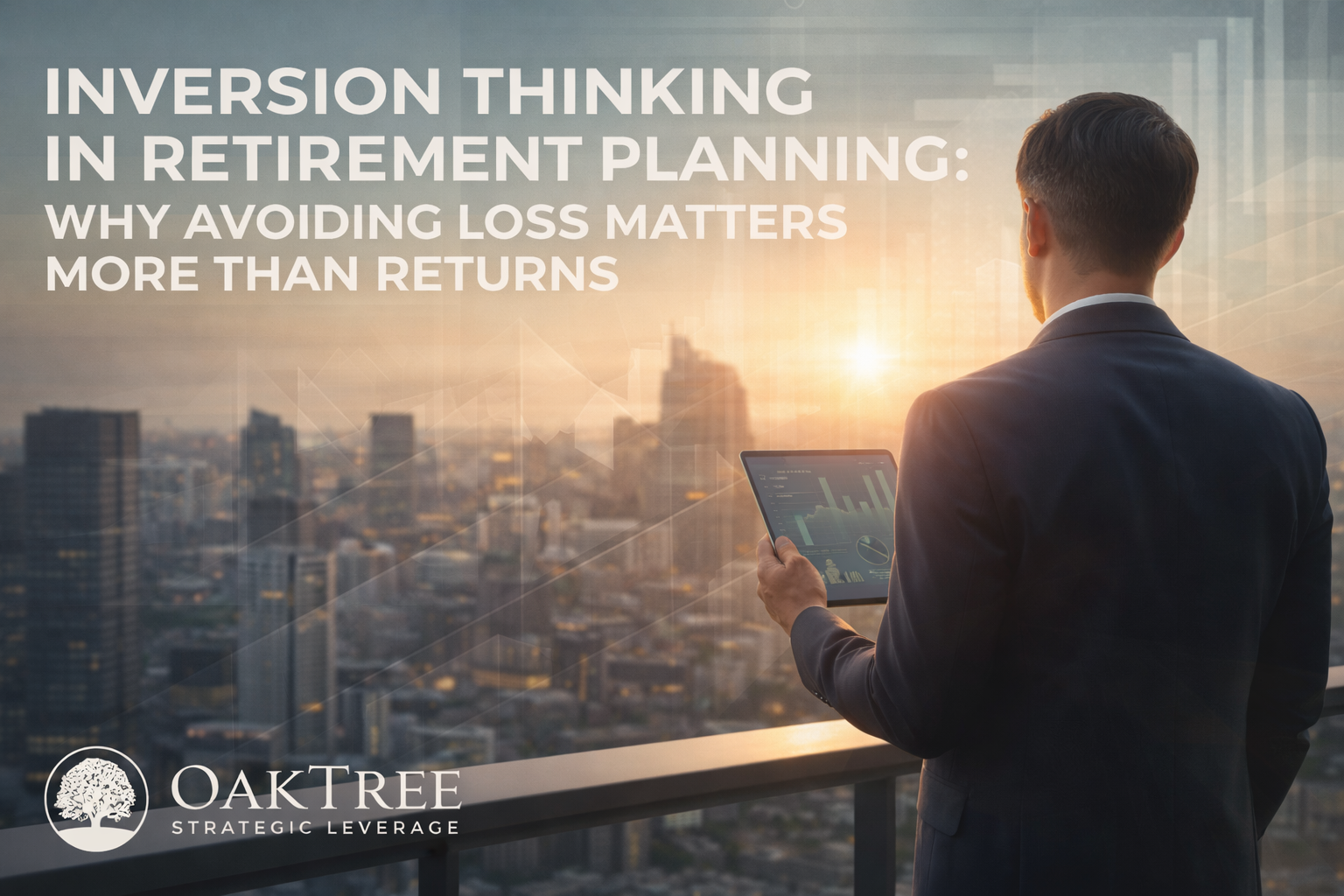
Rethinking How Retirement Planning Starts
Most retirement planning begins with a familiar question: how much return do I need to reach my goal?
Inversion thinking asks a different question first: what causes retirement plans to fail?
For professionals in their 30s and 40s, this shift in perspective matters more than it might initially appear. At this stage of life, the greatest risk to long-term outcomes is rarely a lack of opportunity. It is exposure to avoidable structural mistakes that compound quietly over time.
Inversion thinking, a mental framework popularized in business and decision science, focuses on identifying failure points before optimizing for success. Applied to retirement planning, it reframes the conversation away from performance chasing and toward durability, risk control, and long-term income reliability.
OakTree Strategic Leverage builds its Kai-Zen planning philosophy on this inverted approach, prioritizing the avoidance of permanent loss over the pursuit of short-term gains.
What Is Inversion Thinking?
Inversion thinking is a problem-solving method that works backward from failure rather than forward from success.
Instead of asking:
-
How do I maximize returns?
It asks:
-
What destroys long-term outcomes?
-
What risks cannot be recovered from?
-
Where do traditional assumptions break down?
This framework is widely used in engineering, aviation, and institutional finance because it reduces catastrophic errors rather than optimizing marginal gains.
In retirement planning, inversion thinking shifts the focus from best-case projections to worst-case vulnerabilities.
Why Traditional Retirement Planning Ignores Inversion
Most conventional retirement advice is built on accumulation models. Contribute consistently, invest aggressively early, and reduce risk later.
This model works well in ideal conditions. It struggles in real life.
According to Vanguard research, the majority of retirement shortfalls are not caused by poor savings habits. They are caused by:
-
Market downturns at inopportune times
-
Emotional investment decisions
-
Tax inefficiencies during distribution
-
Inflexible withdrawal rules
These are structural risks, not behavioral ones. Traditional planning often treats them as secondary considerations.
Inversion thinking treats them as primary.
The Four Most Common Retirement Failure Points
When viewed through an inversion lens, retirement planning failures tend to cluster around a few repeat patterns.
1. Sequence of Returns Risk
Sequence of returns risk occurs when market losses happen early in retirement, permanently reducing income sustainability.
Morningstar studies show that retirees experiencing poor early returns can see sustainable income reduced by 20 percent or more, even if long-term average returns remain strong.
Avoiding early losses often matters more than achieving higher average returns.
2. Volatility Drag During Distribution
Market volatility has a compounding effect when withdrawals are involved.
Selling assets during downturns locks in losses and reduces the capital base available for future recovery. Over time, this drag quietly erodes income capacity.
3. Tax Risk and Policy Uncertainty
Many retirement plans assume future tax conditions similar to today’s environment.
IRS and Congressional Budget Office data suggest long-term fiscal pressure will likely increase future tax complexity. Retirement income that lacks tax flexibility is vulnerable to policy shifts.
4. Rigid Income Structures
Required minimum distributions, limited withdrawal windows, and inflexible account rules reduce adaptability.
Inversion thinking prioritizes flexibility because rigidity amplifies risk when conditions change.
Inversion Thinking vs Traditional Optimization
The contrast between traditional planning and inversion-based planning is stark.
| Planning Focus | Traditional Approach | Inversion Thinking |
|---|---|---|
| Primary Question | How much return is needed? | What causes failure? |
| Risk Treatment | Secondary | Primary |
| Market Volatility | Accepted | Managed |
| Income Planning | Deferred | Integrated |
| Tax Flexibility | Limited | Intentional |
This difference in starting point leads to materially different strategies over time.
How Kai-Zen Applies Inversion Thinking
Kai-Zen planning was built by asking what consistently undermines long-term retirement outcomes.
Rather than optimizing portfolios for maximum upside, Kai-Zen focuses on:
-
Reducing exposure to irreversible losses
-
Managing volatility during income years
-
Improving tax control over decades
-
Structuring income flexibility from the beginning
This inversion-based framework informs every design decision within Kai-Zen.
Indexed universal life structures, strategic leverage, and conservative modeling assumptions are not chosen for excitement. They are chosen to reduce known failure points.
Retirement Risk Management Through Structure
Inversion thinking reframes risk management away from prediction and toward structure.
Instead of forecasting markets, Kai-Zen uses:
-
Downside-protected growth mechanisms
-
Tax-advantaged income access
-
Long-term funding discipline
-
Structural separation from daily market volatility
According to Federal Reserve data, households with diversified income sources and flexible withdrawal options experience significantly lower retirement stress than those relying on a single asset class.
Structure creates optionality. Optionality reduces failure risk.
Why Avoiding Loss Often Matters More Than Higher Returns
The math of loss is unforgiving.
A 30 percent loss requires a 43 percent gain to recover. When withdrawals are involved, recovery becomes even more difficult.
For professionals with long careers ahead of them, avoiding large losses early and late in the retirement timeline often produces better outcomes than chasing incremental gains during accumulation.
This is the core insight inversion thinking brings to retirement planning.
Who Benefits Most From an Inversion-Based Approach
Inversion thinking resonates most with individuals who:
-
Value predictability over speculation
-
Are concerned about long-term income stability
-
Want to manage tax and policy uncertainty
-
Prefer systems over tactics
These individuals are often professionals in their 30s and 40s who are building toward complexity rather than simplicity.
Frequently Asked Questions
Is inversion thinking too conservative for younger professionals?
No. Inversion thinking does not eliminate growth. It prioritizes durability so growth is not undermined by avoidable risks.
Does Kai-Zen avoid market exposure entirely?
No. Kai-Zen participates in market-linked growth while reducing downside exposure and volatility risk.
Is avoiding loss more important than returns?
Over long timelines, yes. Avoiding large losses preserves capital, flexibility, and future income capacity.
Can inversion thinking work alongside traditional investing?
Yes. Many individuals use inversion-based strategies alongside traditional portfolios for balance.
Is inversion thinking suitable for everyone?
No. It aligns best with individuals who value long-term structure and disciplined planning.
A More Durable Way to Think About Retirement
Retirement success is rarely the result of exceptional performance. It is more often the result of avoiding preventable failure.
Inversion thinking brings this reality to the forefront. By identifying what breaks retirement plans and designing around those risks, strategies like Kai-Zen aim to create outcomes that are resilient rather than reactive.
OakTree Strategic Leverage works with professionals nationwide to apply inversion-based thinking to long-term retirement planning. For those focused on income durability, tax efficiency, and structural clarity, understanding inversion thinking may be an essential first step.
Continue the Conversation
This article introduces how inversion thinking shapes long-term retirement planning through structure, risk management, and durability. OakTree Strategic Leverage will explore these ideas further in an upcoming webinar focused on why avoiding loss and structural failure often matters more than pursuing higher returns.